Less Is Everything: The Art of Saying Nothing — and Meaning All of It
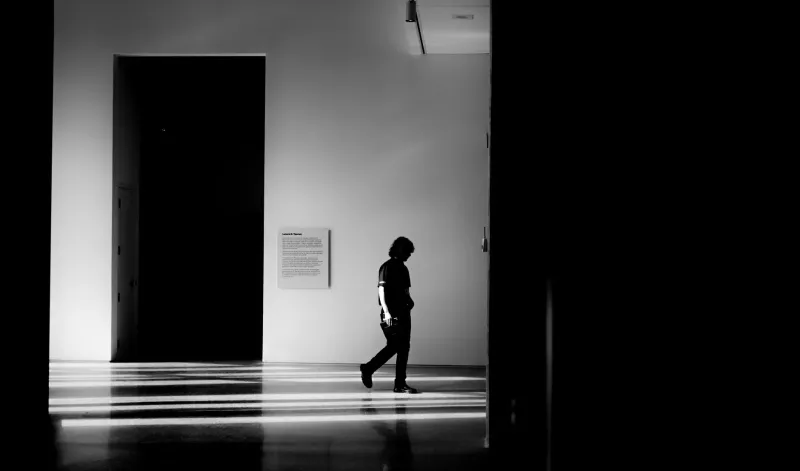
There's a moment in a lot of Katsumi Hayakawa's work where everything just... stops. A pause that lasts a beat too long. A canvas where the eye keeps searching for something that was never placed there. A lyric that ends mid-thought, letting the silence carry whatever comes next. First-timers often assume it's a mistake. People who've spent real time with her work know it's the whole point.
Katsumi's relationship with restraint is one of the most misunderstood — and most sophisticated — parts of her creative identity. In a cultural moment that rewards maximalism, noise, and constant stimulation, she keeps choosing the harder thing: the deliberate absence, the held breath, the space that doesn't get filled.
The Pause as Punctuation
In music and performance, silence isn't passive. Any composer will tell you that a rest is as much a note as any pitch — it just lives in the negative. Katsumi seems to have internalized this at a fundamental level. Her pauses aren't awkward gaps waiting to be covered. They're load-bearing walls.
Think about the way she structures emotional climaxes. Where another artist might swell the arrangement, stack the harmonics, and push the audience over the edge, Katsumi tends to strip things back at exactly the moment you'd expect the opposite. The effect is disorienting in the best way — like stepping off a curb you didn't see. Your nervous system catches up half a second later, and by then the feeling has already landed.
This is a technique with serious artistic pedigree. Miles Davis built a career on it. So did Edward Hopper. The Japanese aesthetic concept of ma — the meaningful interval between two structural elements — runs through Eastern art and philosophy in ways that clearly resonate in Katsumi's sensibility. But she's not simply transplanting a cultural practice into a new context. She's made it her own, bending it toward something personal and immediate.
What the Canvas Doesn't Say
In her visual work, Katsumi's use of negative space operates like a conversation partner. The empty areas don't feel abandoned — they feel chosen. There's a kind of tension between what's rendered and what's withheld that keeps the eye moving, keeps the brain reaching.
One of the more striking examples is the way she handles background in her mixed-media pieces. Other artists crowd the frame. Katsumi tends to isolate her central subjects in wide fields of near-nothing — a wash of muted tone, a texture so subtle you almost doubt it's there. The result is that the subject becomes almost unbearably present. You can't look away, because there's nowhere else to go. The emptiness isn't backdrop. It's pressure.
American audiences, raised on visual media that competes aggressively for attention, sometimes find this initially underwhelming. There's a trained expectation for density, for busyness, for content stacked against content. Katsumi's work asks you to slow down and recalibrate. When you do — and this is the part that surprises people — the emotional payoff is significant. The restraint has been building something the whole time. You just weren't watching the right thing.
Omission as Argument
There's also something philosophically interesting happening in what Katsumi chooses to leave out. Her omissions aren't random. They're editorial. When she cuts a line, drops a detail, or refuses to resolve a visual tension, she's making an argument: that the audience doesn't need to be guided to the meaning. That meaning can be trusted to arrive on its own if you give it room.
This is a genuinely generous creative posture, even if it doesn't always read that way. In a media landscape full of artists over-explaining themselves — in interviews, in liner notes, in endless social media captions that tell you exactly how to feel about the work — Katsumi's refusal to fill in the blanks can seem withholding. It's actually the opposite. She's handing the work over to you completely. The unfinished sentence is an invitation.
Fan communities have picked up on this in interesting ways. The interpretive range you see in discussions of her work is unusually wide, even for an artist with her kind of following. People bring wildly different readings to the same piece and all of them feel valid, because she hasn't over-determined the outcome. The gaps are where her audiences live.
Restraint as Resistance
It's worth naming the context here. Katsumi developed and refined this aesthetic in an industry that doesn't naturally reward it. Commercial pressures push artists toward accessibility, toward immediate emotional legibility, toward hooks and payoffs that arrive on schedule. Choosing minimalism — real minimalism, not the sanitized Instagram version — requires a certain kind of stubbornness.
And she has been stubborn about it. Even as her profile has grown and the stakes of each project have increased, the core commitment to restraint has held. She hasn't inflated her sound to fill bigger rooms. She hasn't cluttered her visual work to satisfy galleries looking for more stuff. The discipline has remained.
That consistency matters. It signals that this isn't a stylistic phase or a calculated positioning move. It's a genuine conviction about how art works — about what it needs to do and what it needs to leave undone.
Learning to Listen to the Quiet
If you're coming to Katsumi's work for the first time, the best advice is probably this: resist the urge to fill in the gaps yourself on the first pass. Sit with the silence. Let the negative space do its thing without immediately interpreting it.
The work rewards patience in a way that's increasingly rare. There's no algorithm surfacing the meaning for you. There's no emotional cue telling you when to feel something. It's just you and the piece and the space between you — and that space, if you let it, has a lot to say.
Katsumi Hayakawa has spent her career proving that restraint isn't limitation. It's precision. It's the choice to trust the audience, trust the work, and trust the silence to carry its own weight. In a world that keeps turning up the volume, that's a radical act. And it's one of the things that makes her work last.

